Grace Periods, Cancellation Notices, and What You Really Have
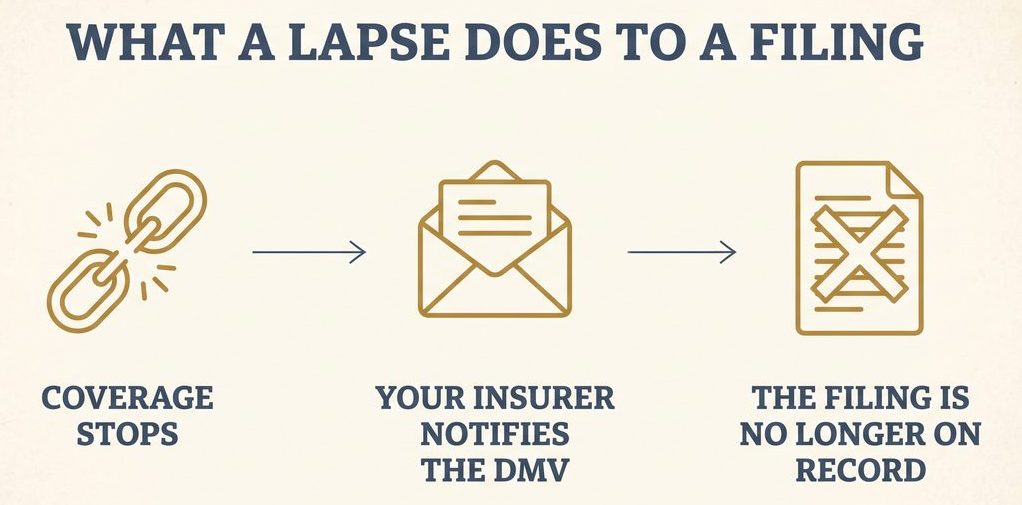
There is no state-issued grace period on the filing itself. The state is watching for a certificate attached to a live policy; the day that stops being true, the insurer's notice goes in. What people are usually thinking of is a carrier's own billing practice, which is a different thing entirely and varies from company to company.
What a late payment actually starts
Missing a due date does not instantly delete your policy. It normally starts a documented process: the carrier issues a notice stating a date on which coverage will end unless payment is received. Everything hinges on that date.
There is a fuller write-up of SR-22 insurance in California on the Auto World Insurance Services site.
Whether any leeway exists before the notice, how many days the notice runs, and whether a payment on the final day restores the policy without a break are all set by the carrier and the policy language. Ask yours the specific question — "what is my cancellation date and what exactly reverses it?" — rather than relying on what happened with a previous company.
Why this matters more with a filing
For an ordinary driver, a short lapse is an expensive inconvenience. With a certificate attached, the same lapse becomes a report to the DMV, and reports to the DMV have consequences for your license, not only your wallet. Your requirement can be extended, and reinstatement steps you have already completed can come around again.
The asymmetry is the entire point: the cost of prevention is one phone call, and the cost of the failure is measured in months.
What to do if the date is coming and the money is not
- Call before the date. Options exist before a cancellation that do not exist after one — a different due date, a rearranged instalment, a different payment plan.
- Ask exactly what reverses it, and whether coverage would be continuous or reinstated with a gap. Those are different answers.
- If the policy is genuinely going to end, arrange the replacement first, effective on or before that date, with its filing confirmed.
What we tell every caller in this position
Make the payment date the most protected date in your month. Autopay from an account that will hold a balance, a backup card on file, and the number for your carrier saved before you need it. In our office this is the failure we see most often, and it is almost always a calendar problem rather than a money problem — the person had the funds two days later.
Reinstatement means two different things
The word gets used on both sides of this and the two meanings are unrelated:
- Policy reinstatement — your insurer agreeing to put a lapsed policy back in force. Discretionary, company-specific, and sometimes offered with a gap in coverage rather than without one.
- License reinstatement — the DMV restoring your driving privilege after its conditions are met, including its own fee.
A carrier saying "we can reinstate you" is not the DMV saying anything at all. When you are told the policy is reinstated, ask the follow-up: was there a gap in coverage, and was a new certificate filed? Those two answers determine whether the state's file shows continuity or a break.
If it has already lapsed, do not spend the afternoon reading. Get coverage back in force today and then sort out what the record shows. Start here and tell us the date it stopped.
Get this quoted for your situation
Free quotes from multiple carriers, prepared by a licensed California agent. Two minutes, no obligation.
Get My Free QuoteMore of what callers ask
How many days late can I be?
There is no universal number, and treating any as safe is how requirements get extended. Get the specific cancellation date from your carrier in writing and work backwards from it.
If I pay after the cancellation date, am I covered again?
Sometimes a carrier will reinstate, sometimes only with a gap, sometimes not at all. It is discretionary. That uncertainty is why the call before the date matters so much.
Does one missed payment extend my requirement automatically?
Not automatically — it depends on whether coverage actually ended and what the DMV does with the notice. Check your record rather than assuming either the best or the worst.