SR-22 vs Regular Insurance — Less Different Than You Think
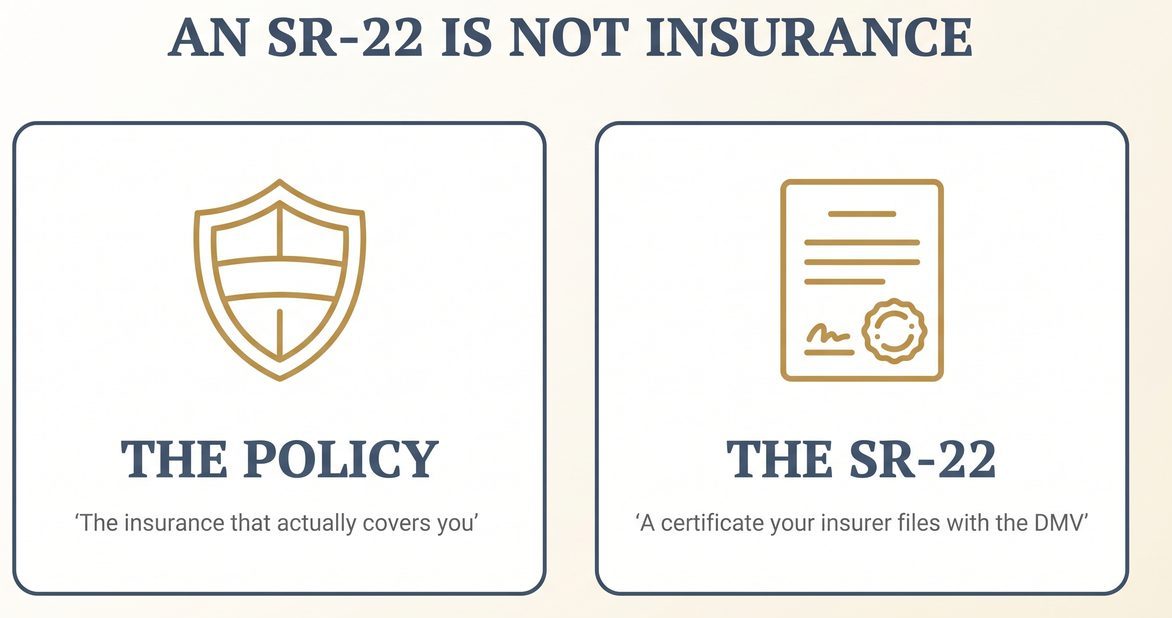
Put two policies side by side — one with an SR-22 filing, one without — and the coverage pages read the same. Liability limits, optional coverages, ID cards, claims process: identical machinery. The differences are real but narrow, and knowing exactly where they live saves you from paying for imaginary ones.
Difference one — the filing and its tether
The SR-22 policy reports to the DMV. Active, the filing satisfies your requirement; lapsed, the carrier must say so, and the state responds. A regular policy lapsing is a private problem you fix with a reinstatement or a new policy; an SR-22 policy lapsing is a DMV event. That tether is the requirement, in one sentence.
Before you buy, the guide to SR-22 insurance is worth ten minutes.
Difference two — who will write it
Every licensed carrier writes "regular" insurance. Only some file SR-22s, and it's each company's own call. This shrinks your market — and reshapes it, because the specialists who remain actually compete for filing business rather than merely tolerating it.
Difference three — what the record behind it costs
The premium difference people attribute to "SR-22 insurance" is mostly the violation that caused the requirement, priced into your record. The form itself adds a small one-time filing fee. Blaming the form for the price is like blaming the cast for the broken arm.
What's identical
Your obligations while driving — including carrying proof under Vehicle Code 16028 — the state minimum limits of $30,000/$60,000/$15,000, how claims work, and your right to shop carriers at any renewal. The requirement constrains which carriers, never whether you may compare.
Need the filing version? Quote it here — carriers that file, violation stated plainly, numbers you can act on.
What shopping looks like while a filing is active
You can change carriers during a requirement — you are not locked in — but the sequencing matters more than it does for an ordinary policy. The new carrier's filing has to be in place before the old policy ends, or the DMV sees a gap. In practice: quote first, bind the new policy with the filing arranged, confirm it has actually been filed, and only then cancel. Never cancel first. The savings from switching are real; the cost of a gap in between is not worth them.
Get this quoted for your situation
Free quotes from multiple carriers, prepared by a licensed California agent. Two minutes, no obligation.
Get My Free QuoteQuestions we hear on this
Is 'SR-22 insurance' a special product I have to ask for by name?
Ask for insurance WITH an SR-22 filing — that phrasing gets you quoted correctly. The product is a normal policy; the filing is the add-on, and only some carriers offer it.
Can I have full coverage on an SR-22 policy?
Yes. The filing requires the liability minimums be met; nothing stops you adding comprehensive and collision like any other policy. Lenders still require them on financed cars, filing or not.
Do SR-22 policies have different claims handling?
No. Claims run exactly like any policy with that carrier. The DMV reporting tether concerns the policy's EXISTENCE, not how a fender-bender gets handled.