What an SR-22 Actually Is — and Isn't
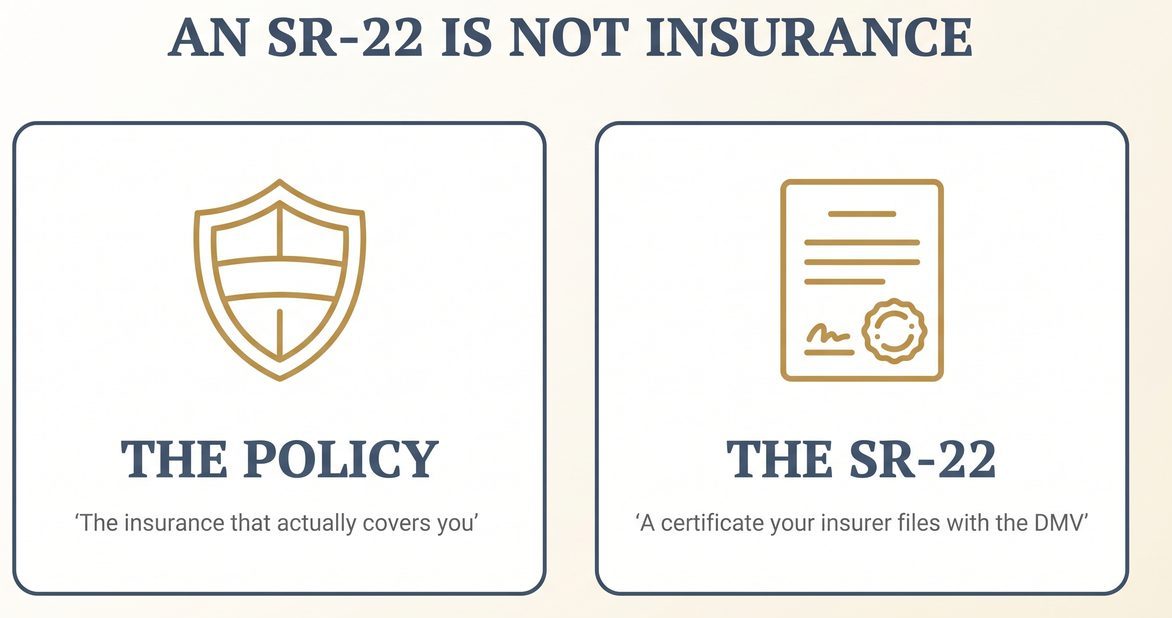
The most useful thing anyone can tell you about an SR-22 is that it is not a kind of insurance. It's a one-page certificate your insurance company files electronically with the California DMV, promising the state that your liability coverage is real and active. If that coverage ever stops, the insurer is obligated to tell the DMV — that report is called an SR-26, and it's how the state finds out the moment a required policy lapses.
You can't file an SR-22 yourself, and you can't buy one at the DMV counter. Only an insurance company that writes California policies can submit it, attached to an actual auto policy. That's the whole product: an ordinary liability policy, plus a filing.
Who gets told to carry one
The DMV or a court orders the filing, usually as a condition of getting a suspended license back. The common triggers are a DUI conviction, driving without insurance — especially being caught uninsured at a traffic stop or in a crash — and certain suspensions where the state wants ongoing proof before it trusts you with a license again. Your reinstatement paperwork will say the words "SR-22" or "proof of financial responsibility" if it applies to you.
The broker behind this page keeps a longer explainer on SR-22 insurance, with the statute links.
What the filing has to prove
The policy behind the filing must meet California's minimum liability limits — $30,000 per person and $60,000 per accident for injuries, and $15,000 for property damage. Those are the same minimums every California driver must carry; the SR-22 doesn't raise them, it just makes your compliance visible to the state. And under Vehicle Code 16028, you still carry evidence of that coverage whenever you drive, filing or no filing.
The part people get wrong
In our office, the single most common misunderstanding is treating the SR-22 as a separate bill or a separate company. It isn't. You pick a carrier that offers filings — not all do — and the filing rides along with the policy, usually for a small one-time fee. The real cost difference comes from the violation that caused the requirement, not the form itself.
If your paperwork says you need one, a broker who files SR-22s every week can have the policy issued and the form transmitted the same day. Two minutes on a quote is faster than an hour of DMV reading — start yours here.
Get this quoted for your situation
Free quotes from multiple carriers, prepared by a licensed California agent. Two minutes, no obligation.
Get My Free QuoteQuestions we hear on this
Is an SR-22 a type of car insurance?
No. It's a certificate your insurer files with the DMV proving you carry an active liability policy. The insurance is an ordinary policy; the SR-22 is the state's window into it.
Can I get an SR-22 without owning a car?
Yes — that's a non-owner SR-22: a liability policy that covers you driving borrowed or rented cars, with the filing attached. It's the standard route when your license requires the form but you don't currently have a vehicle.
Does every insurance company file SR-22s?
No, and this is set by each company. Some big-name carriers decline the business entirely, which is why the fastest route is a broker who already knows which of their carriers file same-day.